ESP32 MAX Pinout: Master AceBott Expansion Boardquickly
Discovering the Acebott ESP32 MAX's vast potential involves diving into its extensive pinout map. The ESP32 MAX, an upgrade from the ESP32-S3, boasts an impressive array of functionalities, thanks to its robust pin configuration. Let's embark on this journey to explore the Acebott ESP32 MAX pinout, your key to unlocking a world of possibilities.
The Acebott ESP32 MAX, built on the powerful ESP32-S3 core, is a game-changer in the IoT realm, offering a perfect blend of versatility, power efficiency, and connectivity. With 26 GPIO pins, it's a playground for hobbyists and professionals alike, catering to a wide range of projects like smart home automation, industrial control, and wireless sensing.
Core GPIO Functionality
The Acebott ESP32 MAX's GPIO pins support a myriad of functions, paramount to its versatile nature. These include general-purpose inputs/outputs, UART, SPI, I2C, I2S, pulse-width modulation (PWM), and analog-to-digital converters (ADC).


Such flexibility means you can interface the ESP32 MAX with countless peripherals, from displays and sensors to motors and actuators, making it an ideal heart for any project requiring extensive GPIO functionality.
Power and Reset Pins
The ESP32 MAX comes with four power-related pins: VDD33, VSS (Ground), VDDS (Core power), and VDDA (Analog power). These manage the chip's power input and help regulate the core and analog circuits separately.


Additionally, the RST (Reset) pin enables you to manually reset the microcontroller, vital for debugging and ensuring smooth operation during development.
Communication Interfaces
The Acebott ESP32 MAX hosts diverse communication interfaces, making it easy to connect with various components and devices.
For instance, it offers two UART interfaces (U0, U1), two SPI interfaces (HSPI, VSPI), and two I2C interfaces (I2C0, I2C1). It also features an I2S stereo DAC (Digital-to-Analog Converter) interface, enabling audio processing and playback.


Analog and Digital Pins
Among the 26 GPIO pins, five serve as ADC inputs, allowing you to read analog voltage levels from sensors and other voltage-based circuits. These five pins can also toggle their functionality, serving as GPIO pins as needed.
Furthermore, the ACEBOTT ESP32 MAX houses 17 digital GPIO pins that can act either as inputs or outputs. These extensive I/O capabilities make the ESP32 MAX an excellent choice for large-scale projects and complex systems.
Interrupt Pins
The ACEBOTT ESP32 MAX comes with 14 interrupt-capable GPIO pins, empowering you to trigger specific actions in response to external events. This feature is essential for real-time applications, such as smart alarms and safety systems.


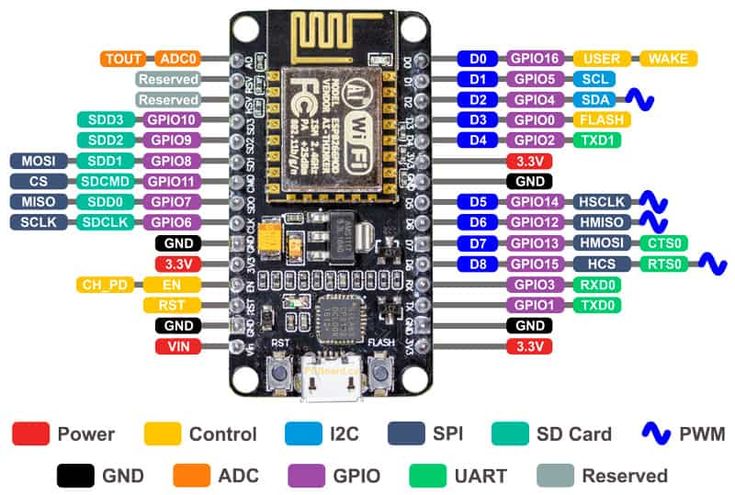


Moreover, these interrupt pins can operate with various input modes, including edge (rising or falling) and level (high or low), ensuring you capture exactly the events you're interested in.
High-Speed and Low-Speed Pins
The ESP32 MAX also distinguishes between high-speed (HS) and low-speed (LS) GPIO pins. HS pins provide high-speed I/O operation, ideal for quick data transfer and high-performance applications. LS pins, on the other hand, cater to slower, power-efficient operations.
By cleverly orchestrating the use of HS and LS pins within your project, you can optimize power consumption and system performance, crucial for long-running and resource-constrained IoT devices.
The Acebott ESP32 MAX's extensive pinout, covering diverse functionalities and data interfaces, is nothing short of impressive. To fully harness its potential, we encourage you to delve deeper into the official documentation, explore community projects, and experiment with your ideas. The Acebott ESP32 MAX is your key to unlocking a realm of possibilities, waiting to be discovered and tapped into. So, código y acción – code and action – are your gateways to your next innovative project.
Related Articles

Upgrade Your ESP32 Project: Acebott Camera Expansion Pack
Elevate your ESP32 projects with the ACEBOTT ESP32 Camera Expansion Pack, a game-changer for adding visual perception to your IoT applications. This robust and...

ESP32 Acebott Pinout Reference: All Pins Explained
The AceBot ESP32, a remarkable Wi-Fi and Bluetooth Low Energy (BLE) SoC (System on Chip) module, is a popular choice among hobbyists and professionals alike...

Master Acebott ESP32 Max V1.0 Development Board Unleashed
The ACEBot ESP32 Development Board Max V1.0, a robust and versatile tool, has gained significant traction among IoT enthusiasts and professionals alike. This...
ESP32 ACEBOTT MAX V1.0 Pinout Guide
The ACEBott ESP32 MAX V1.0 is a robust and compact development board designed for the ESP32-WROOM-32 module, offering a wealth of connectivity options for your...

Best esp32 Projects: ACEBOTT - Top Kits & Tutorials
The Acebott ESP32, a product of Acebott Technology Co., Ltd., is a powerhouse in the world of IoT development. Combining the strength of the ESP32 chips with...

Attached Master: Small Deck Expansion Ideas
Transforming a home's layout can often start with the most intimate of spaces, the master bedroom. One unique and increasingly popular way to enhance this...