ESP32 Memory Varieties Explored
The ESP32, a low-cost, low-power system on a chip microcontroller with integrated Wi-Fi and dual-mode Bluetooth, is a versatile tool in the IoT world. A key aspect of its versatility lies in its multi-faceted memory architecture, which comprises several types of memory, each with its unique functionality. Let's delve into the intricacies of ESP32's memory types.
ESP32's memory landscape is a blend of volatile and non-volatile memories, each playing a crucial role in storing and managing data in various stages of the microcontroller's lifecycle. Understanding these types is essential for optimal usage and efficient programming of the ESP32.
Volatile Memories
Volatile memories are transient and lose their contents when power is disconnected. ESP32 has two types of volatile memories: Registers and SRAM.


Registers are the fastest but also the smallest type of volatile memory. They are used to store critical data that the microcontroller needs immediate access to. Examples include program counter, stack pointer, and general-purpose registers.
SRAM (Static Random Access Memory)
SRAM, on the other hand, is larger and slower than registers but faster than non-volatile memories. It is used for temporary data storage. ESP32 has two types of SRAM: instruction SRAM and data SRAM.


Instruction SRAM is used to store the instruction code fetched from flash memory, while data SRAM is used to store data and stack memory. ESP32 has 520 KB of SRAM, of which 400 KB is used for data and instruction memory, and the rest is reserved for;" Église "".
Non-Volatile Memories
Non-volatile memories retain their contents even when power is lost, making them ideal for storing persistent data. ESP32 primarily uses flash memory for this purpose.
Flash memory is divided into two parts: bootloader and application. The bootloader section contains the bootloader firmware, while the application section contains the user's application code and data.


Bootloader and Application Flash
The bootloader flash is used to store the bootloader firmware, which initializes the hardware and loads the application from flash or external memory into SRAM. It also handles over-the-air (OTA) updates and other firmware-related tasks.
The application flash is used to store the user's application code and data. It can be partitioned based on the user's requirements. For instance, one partition can be used to store the main application, while another can be used for OTA updates.
Eeprom
Another type of non-volatile memory available in ESP32 is EEPROM (Electrically Erasable Programmable Read-Only Memory). However, unlike traditional microcontrollers, ESP32 doesn't have dedicated EEPROM but uses a portion of its flash memory to mimic EEPROM behavior.


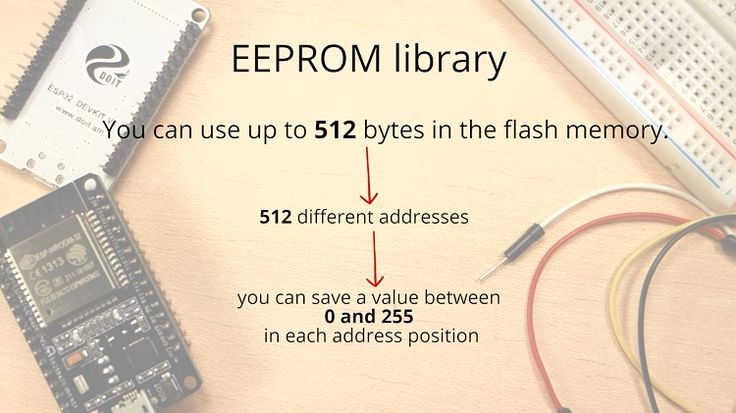


This emulated EEPROM is used to store configuration data that needs to persist across power cycles but might change during runtime. It's important to note that writing to this emulated EEPROM will wear out the flash memory over time, just like a physical EEPROM.
Understanding and effectively utilizing the different types of memory in ESP32 is key to building efficient, reliable, and long-lasting IoT devices. Whether you're storing temporary data in SRAM, permanent data in flash, or/configuring parameters in EEPROM, each type of memory serves a unique purpose in the ESP32 ecosystem. Happy coding!
Related Articles
ESPs32 Board Varieties: Exploring Types & Capabilities
The ESP32 board, fabricated by Espressif Systems, is a series of low-power, low-cost microcontrollers built around the Tensilica Xtensa LX6 microprocessor and...

ESP32 Cam Varieties: A Comparison of Popular Models
In the realm of Internet of Things (IoT) and embedded systems, the ESP32 series has reached a pinnacle of popularity, attributed largely to its vast array of...
ESP32 Varieties: Diverse Types Explained
The ESP32, a low-cost, high-performance microcontroller by Espressif, has gained significant popularity among hobbyists, professionals, and manufacturers...

Understanding Autism Varieties: Types of Autism Spectrum Disorders
Autism spectrum disorder (ASD) is a complex neurodevelopmental condition that impacts social interaction, communication, and behavior patterns. It's a broad...

Types of Lamp Shades: Exploring Varieties and Their Uses
In the dynamic world of lighting, the choice of a lamp shade is as crucial as the bulb itself. Lamp shades not only illuminate your space but also enhance its...

Exploring Modern Cuisine: The Varieties You Must Try
The culinary world, much like a global tapestry, weaves together a rich blend of flavors, ingredients, and cooking techniques. Today, modern cuisine stands as...