AI Revolutionizing Infrastructure: The Role of Artificial Intelligence
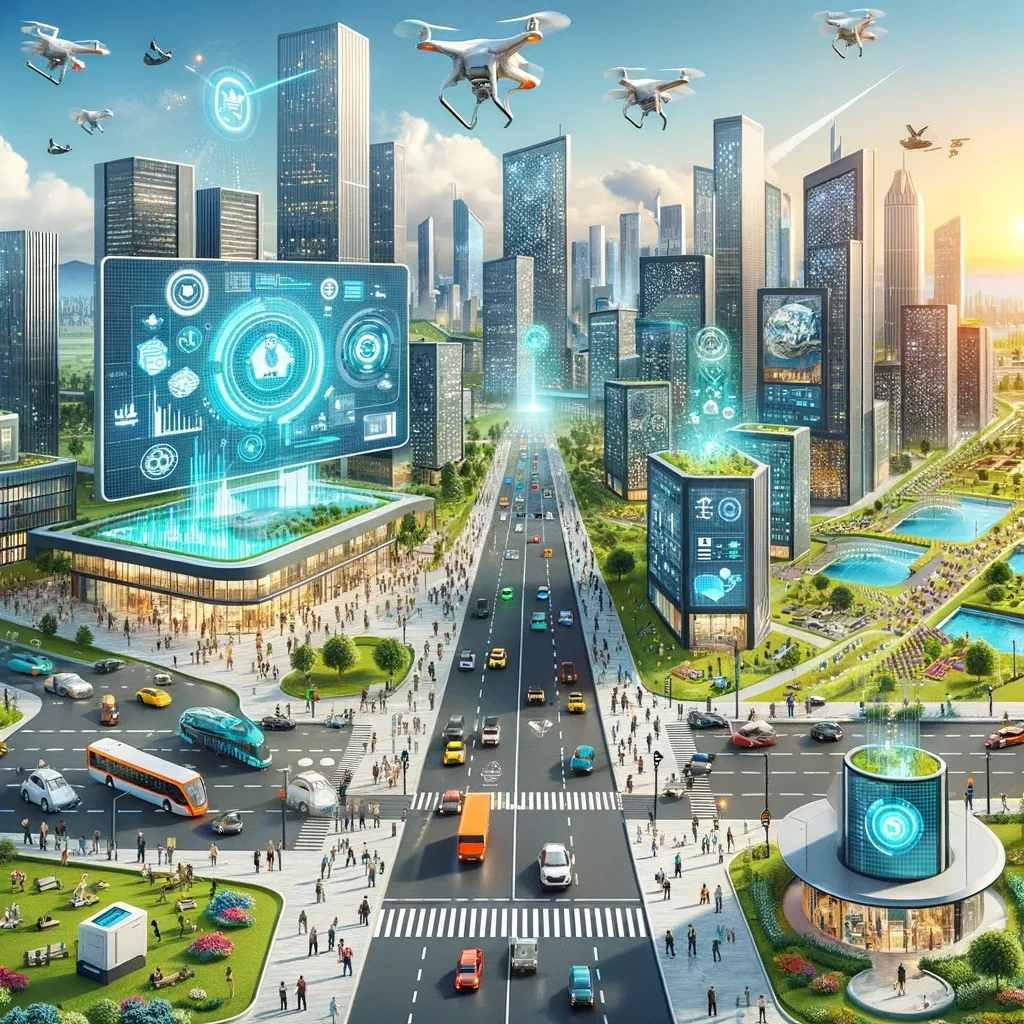
The role of Artificial Intelligence (AI) in infrastructure development and management has evolved significantly in recent years, transforming the way we plan, build, and maintain our cities and transportation networks. AI's ability to process vast amounts of data, learn from it, and make informed predictions has opened up new avenues for enhancing infrastructure efficiency, resilience, and sustainability.
AI's impact spans across various aspects of infrastructure, from design and construction to operation and maintenance. It is revolutionizing industries like urban planning,transportation, energy, and water management, enabling smarter decision-making and resource allocation. In this article, we explore some of the key roles AI plays in infrastructure and how it is reshaping our urban landscapes.
AI in Infrastructure Planning and Design
AI is increasingly being used in the early stages of infrastructure development to improve planning and design. It helps urban planners and architects make data-driven decisions, optimize resource allocation, and predict environmental and societal impacts.


One of the most prominent tools in this regard is Generative Design, a design approach that uses AI to generate multiple solutions based on defined parameters. It allows designers to explore a wide range of options, optimizing performance and streamlining the design process.
Urban Planning and Layout Optimization
AI can analyze various data sets, including population density, transportation routes, and utilities, to suggest optimal urban layouts. By using machine learning algorithms, planners can simulate different urban development scenarios, identifying the most efficient and environmentally friendly layouts.


For instance, the city of Barcelona is using an AI-driven model to optimize its urban planning. The model uses machine learning to predict which zones are most suitable for different types of urban development, helping the city create a more sustainable and resilient urban structure.
Predictive Modeling for Infrastructure Demand
AI can predict future demands for infrastructure based on historical data and demographic trends. This helps infrastructure providers future-proof their investments and avoid overcapacity or undercapacity. By using predictive models, authorities can better anticipate growth in population, industries, and services that will require more infrastructure.
A notable example is the Pivot urban planning platform, which uses AI to predict future urban demand. It helps urban planners make informed decisions on land usage, infrastructure investment, and transportation services.


AI in Infrastructure Construction
AI is also transforming the construction industry by improving efficiency, safety, and quality. It is enabling real-time data collection and analysis, predictive maintenance, and automated decision-making on construction sites.
The application of AI in construction varies from automating routine tasks to complex problem-solving. Here, we highlight two key areas of AI's impact on construction.
Construction Automation and Robotics
AI-powered robots and drones are taking over dangerous and repetitive tasks in construction, reducing human error and increasing efficiency. From bricklaying to waterproofing, these autonomous machines are revolutionizing the construction process, making it faster and less labor-intensive.




In the UK, the world's first autonomous construction site used AI-powered robots to construct a 3D-printed office building. The project showcased how AI can optimize construction processes, reduce costs, and improve safety.
Predictive Maintenance and Quality Control
AI can analyze real-time data from sensors and other devices on construction sites to predict equipment failures and maintenance needs. This helps in minimizing downtime, reducing repair costs, and improving overall efficiency.
Moreover, AI can also be used to monitor the quality of construction materials and finished structures. For example, using AI to analyze thermal images can help identify heat loss in buildings, ensuring they meet energy efficiency standards.
AI in Infrastructure Operation and Maintenance
AI plays a crucial role in the operation and maintenance of infrastructure, enabling real-time monitoring, predictive maintenance, and improved customer experiences. Here, we look at two key areas where AI is transforming infrastructure operation and maintenance.
Infrastructure Asset Management
AI can help infrastructure providers manage their assets more effectively by predicting maintenance needs, optimizing resource allocation, and minimizing downtime. By using machine learning algorithms to analyze historical data, AI can identify patterns and predict when assets are likely to fail, allowing for proactive maintenance.
For instance, the NYC Department of Transportation uses an AI-driven predictive analytics system to manage its bridges. The system uses machine learning to identify bridge components most at risk of failure, helping the city prioritize maintenance work and save on repair costs.
Transportation Optimization and Mobility-as-a-Service
AI is transforming transportation by optimizing route planning, traffic flow, and public transportation schedules. It enables mobility-as-a-service (MaaS) platforms that integrate various transport modes, offering users personalized travel options based on their preferences and real-time traffic data.
A notable example is the MaaS Global platform in Finland, which uses AI to map out the most efficient transport routes for users. By integrating multiple transport options, the platform reduces travel time, helps users save money, and encourages more sustainable mobility practices.
As AI continues to advance, its role in infrastructure development and management will only grow. From optimizing urban planning to enabling predictive maintenance, AI offers countless opportunities to create smarter, more efficient, and sustainable infrastructure. Embracing these technologies will be key to building resilient urban environments that can adapt to the challenges of the 21st century. The future of infrastructure is smart, and AI is the engine driving this transformation.
Related Articles
Revolutionizing IT Infrastructure: Harnessing the Power of Artificial Intelligence
The integration of Artificial Intelligence (AI) in Information Technology (IT) infrastructure has been a game-changer, revolutionizing the way we manage...

5 Creative Ways AI is Revolutionizing Industries
Artificial Intelligence (AI) has cemented its place as a transformative force in numerous industries, offering innovative solutions and enhancing efficiency...

Harnessing AI: The Pivotal Role in Smart City Evolution
Artificial Intelligence (AI) is no longer an abstract concept confined to science fiction. It's rapidly embedding itself into the fabric of our daily lives...
Artificial Intelligence: Key to Smarter Cities
In the rapidly evolving ecosystem of urban development, the introduction of artificial intelligence (AI) has emerged as a game-changer, transforming cities...

3 Ways AI is Currently Revolutionizing Industries
Artificial Intelligence (AI) has permeated various aspects of our daily lives, from entertainment to healthcare. Its influence is widely felt, yet sometimes...

Revolutionizing Wellness: Top AI Applications in Healthcare
Artificial Intelligence (AI) is transforming numerous sectors, and healthcare is no exception. AI's potential lies in its ability to analyze vast amounts of...